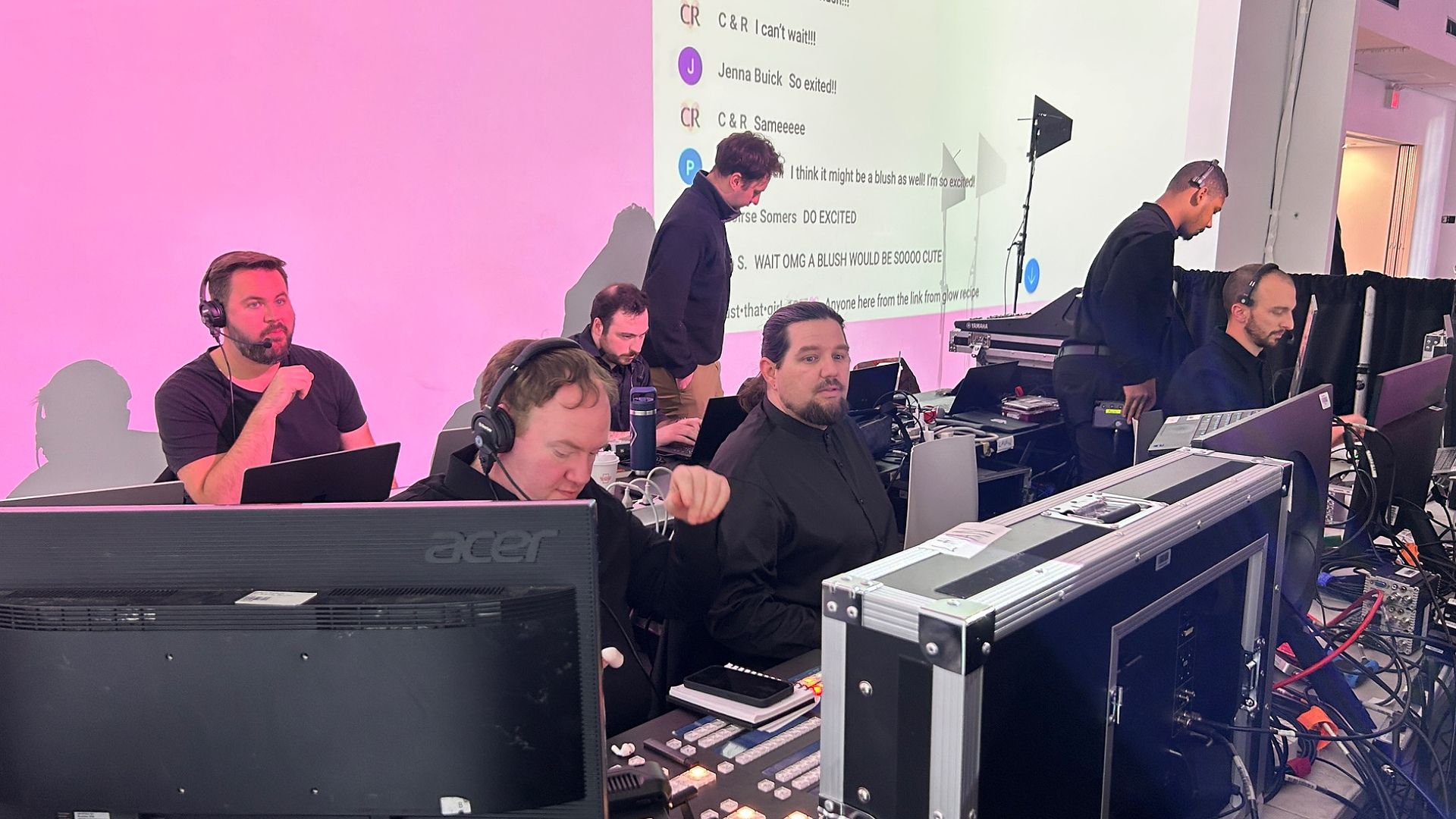
Today’s live events often have two audiences: the people in the room and the people watching from somewhere else. Executive broadcasts, leadership panels, investor communications, year-end stakeholder programs, town halls, and high-visibility corporate events increasingly need to perform equally well for both.
That changes how the event should be produced from the beginning. Camera positions, scenic choices, lighting, audio, presentation content, sightlines, playback, and audience interaction all need to support the live experience while also creating a polished broadcast.
Wizard Studios produces broadcast-ready corporate and institutional events across New York and the East Coast, while the combined national capabilities of Wizard Studios and VOX Productions allow clients to extend that same production approach across both coasts and into multi-market programs.
Producing for the Room and the Screen at the Same Time
An event that looks impressive in person does not automatically translate well on camera. Scenic pieces may block camera angles. Lighting that feels atmospheric in the room may leave speakers underexposed. Screens may look clear to the audience but create flicker or glare on video. A stage configuration that works for 500 guests may not create strong compositions for a multi-camera shoot.
Broadcast-ready production considers those issues before load-in.
The production plan should account for camera placement, presenter blocking, stage depth, scenic backgrounds, audience sightlines, display brightness, lighting for faces, audio feeds, graphics, playback, and transitions between live and remote participants.
When the room and the broadcast are treated as one production, neither audience feels secondary.
Executive Broadcasts and Leadership Communications
Executive communications require a different level of precision because the content is often business-critical. Leadership updates, investor presentations, town halls, annual meetings, and year-end stakeholder communications may be viewed by employees, clients, investors, partners, or media well beyond the venue.
Production can support these programs through multi-camera staging, confidence monitors, teleprompter support, presentation playback, broadcast audio, lighting optimized for speakers, remote contributor integration, branded scenic environments, and technical show calling.
The goal is not to make the event feel like a television studio. It is to create a live environment that still feels natural to the audience while producing a clean, professional broadcast feed.
Panel Capture and Multi-Camera Staging
Panels are among the most common live-event formats, but they can be difficult to capture well if production is not planned for camera.
A panel may require wide shots, individual speaker coverage, audience reactions, moderator close-ups, presentation content, and clean transitions between each source. Microphones need to work for the room and for the broadcast mix. Scenic elements need enough depth to create attractive camera compositions without taking over the stage.
Multi-camera planning can include fixed and roaming camera positions, individual ISO recordings, switched program feeds, confidence monitors, speaker timers, presentation capture, audience microphones, and backup recording systems.
These decisions give the production team more flexibility during the live show and create stronger content for future use.
Remote Audiences Should Feel Included
Broadcast-ready events are not only about recording what happens in the room. They are also about creating a complete experience for remote participants.
Remote audiences need clear audio, readable graphics, strong camera coverage, and a program pace that makes sense on screen. If remote participants are contributing live, their feeds need to be integrated into the room without awkward delays or transitions.
Production may also support moderated Q&A, remote speaker feeds, livestream platforms, virtual green rooms, audience polling, captioning, recording, and post-event content delivery.
When these elements are integrated into the production plan from the beginning, the remote audience becomes part of the event instead of simply observing it.
Lighting and Scenic Built for Broadcast
Broadcast lighting has to accomplish several things at once. It needs to create atmosphere in the venue, keep speakers properly lit, separate subjects from the background, and maintain consistency across camera angles.
Scenic production also becomes part of the broadcast frame. LED walls, stage architecture, branded graphics, furniture, podiums, and scenic textures should be evaluated for how they appear through a lens as well as how they look in person.
For corporate programs, this is especially important because event footage may later appear in internal communications, social media, press coverage, recruitment materials, investor updates, or future marketing campaigns.
Producing the environment for both live and recorded use increases the long-term value of the event.
Audio Is the Foundation of a Strong Broadcast
Guests may forgive a slightly imperfect camera angle. They are far less likely to stay engaged with poor audio.
Broadcast-ready production requires separate attention to the sound in the room and the sound feeding the livestream or recording. Microphone levels, music, videos, remote speakers, audience questions, and presentation audio all need to be balanced for both environments.
A dedicated broadcast mix can help ensure that remote viewers hear clear speech and consistent program audio even when the live room requires a different sound approach.
Content Capture Beyond the Live Program
A broadcast-ready production can create a large amount of reusable content from a single event.
Executive remarks can become short clips. Panels can be repurposed into thought-leadership content. Keynotes can be archived for internal teams. Interviews can support social media. A year-end meeting can generate content for employees who were unable to attend live.
Planning for that use early can influence camera coverage, recording formats, isolated audio tracks, stage blocking, lighting, and the way presentations are captured.
The event can then continue delivering value long after the live program ends.
National Broadcast-Ready Production From Coast to Coast
For organizations operating nationally, broadcast consistency can be just as important as event consistency.
A leadership program may begin in New York and continue in Los Angeles. A company may host executive communications from both coasts throughout the year. An agency may need the same technical standards for a series of stakeholder events across multiple markets.
The combined capabilities of Wizard Studios and VOX Productions help support that need with experienced production resources on both coasts. The objective is to maintain consistent technical standards, visual quality, show documentation, camera workflows, and audience experience while adapting intelligently to each venue and market.
Rather than treating every broadcast as a separate production, national clients can build a repeatable system that becomes more efficient with each event.
One Production Strategy for Live, Remote, and Recorded Audiences
The strongest broadcast-ready events do not feel like compromises. The people in the room still experience a compelling live program. Remote viewers receive a polished broadcast. Recorded content is captured in a way that can continue working after the event.
Wizard Studios brings deep experience in executive broadcasts, panels, corporate communications, staging, lighting, audio, video, and technical production across New York and the East Coast. Together with VOX Productions on the West Coast, clients can access a broader national production platform for programs that need to perform consistently from coast to coast.
For organizations planning executive broadcasts, year-end stakeholder communications, leadership events, panels, or multi-camera programs, the production strategy should begin with one question: how will this experience work for every audience, wherever they are watching?